There are four key components of an AGP:
- Median
- 25th–75th Percentile
- 5th–95th Percentile
- Target Glucose Range
Each of these elements tells a clear story about your patients’ glucose control and variability over a selected time period.
.svg)


Each of these elements tells a clear story about your patients’ glucose control and variability over a selected time period.

The ‘average’ (middle) point of all glucose levels that shows ‘what usually happens’ during a day.2 Look at whether it is in the target glucose range and how much it swings up and down throughout the day.
This band indicates where glucose levels are ‘half the time’. Look at width of the band throughout the day. The wider this band is, the more variable the glucose levels are day-to-day.2
This band indicates more ‘occasional’ high or low glucose levels. Look at areas where the band is widest, this indicates more day-to-day variation at these times.2
This is the corridor where glucose levels should be as much as possible. According to international consensus, the target glucose range is usually 3.9 mmol/L–10 mmol/L for adults with type 1 and type 2 diabetes who are not pregnant, not older, or at risk.3
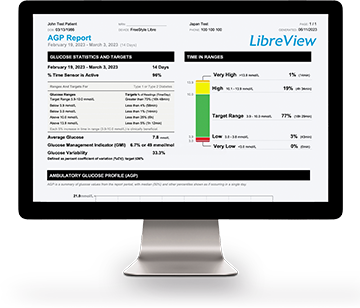

With the AGP report on LibreView you can:
.png)
References & Disclaimers
Images are for illustrative purposes only. Not real patient or data.
₼ The LibreView website is only compatible with certain operating systems and browsers. Please check www.LibreView.com for additional information.
1. Wright, E.E. Jr. and Hirsch, I.B., (2015). The ambulatory glucose profile: a new view of glucose patterns. Journal of Family Practice, 64(12 Suppl), pp.S4–S10.
2. Gibb, F. W., Jennings, P., Leelarathna, L., & Wilmot, E. et al. AGP in Daily Clinical Practice: A guide for use with the Freestyle Libre Flash Glucose Monitoring System. British Journal of Diabetes. Retrieved June 30, 2022, from https://doi.org/10.15277/bjd.2020.240
3. Battelino T, Danne T, Bergenstal RM, et al. Clinical targets for continuous glucose monitoring data interpretation: recommendations from the international consensus on time in range. Diabetes Care. (2019);42(8):1593-1603.
4. Evans, M., Cranston, I. and Bailey, C. (2017). British Journal of Diabetes, 17(1),
ADC-2637241 v2.0 04/26
Alla oleva "Kyllä"-linkki vie sinut muulle kuin Abbott Laboratories -sivustolle. Linkit muille verkkosivustoille eivät ole Abbott Laboratoriesin hallinnassa, eikä Abbott Laboratories ole vastuussa tällaisten verkkosivustojen sisällöstä tai sellaisista linkeistä. Abbott Laboratories tarjoaa nämä linkit sinulle vain avuksi, eikä minkään linkin lisääminen tarkoita, että Abbott Laboratories hyväksyy sivuston.
Haluatko poistua tältä sivulta?
Tämä on tuotekohtainen verkkosivusto, joka on tarkoitettu vain terveydenhuollon ammattilaisille Suomessa. Jos asut toisessa maassa, ota yhteyttä paikalliseen Abbott-toimistoon saadaksesi maatasi koskevat oikeat tuotetiedot.
